You quoted six hours of work and delivered in three weeks. Nobody was slow. Nobody dropped anything. Every person in the chain did their part the day they picked it up. The job spent most of those three weeks stopped, sitting in one inbox, waiting for somebody to say yes. You logged none of it, because while work is waiting nobody is doing anything, and time nobody logs is the only kind that never gets fixed.
WHAT WORKS
Measure wait time, not work time.
Every estimate you have ever given is work time. Hours of effort by somebody actually working. Waiting never enters that number, so it never enters the fix either, and you end up adding people to a problem that has nothing to do with capacity.
Pick one workflow that ends in money changing hands or something being delivered. For the last five real runs of it, write down two dates at every point where the work left your hands: the day it went out, and the day it came back. No tooling. No stopwatch. No process project.
Both dates are already sitting in your sent folder and your inbox. This is a reading exercise, not a tracking exercise, and it is the reason it takes twenty minutes instead of a quarter.
Then add the gaps. Here is the shape it usually takes, with round numbers rather than any real client's.
- Draft out for internal sign-off: 4 days waiting.
- Sign-off out to the client: 6 days waiting.
- Scope question back to the client: 3 days waiting.
- Invoice raised, waiting on a PO number: 5 days waiting.
Eighteen days of calendar. About five hours of effort inside it.
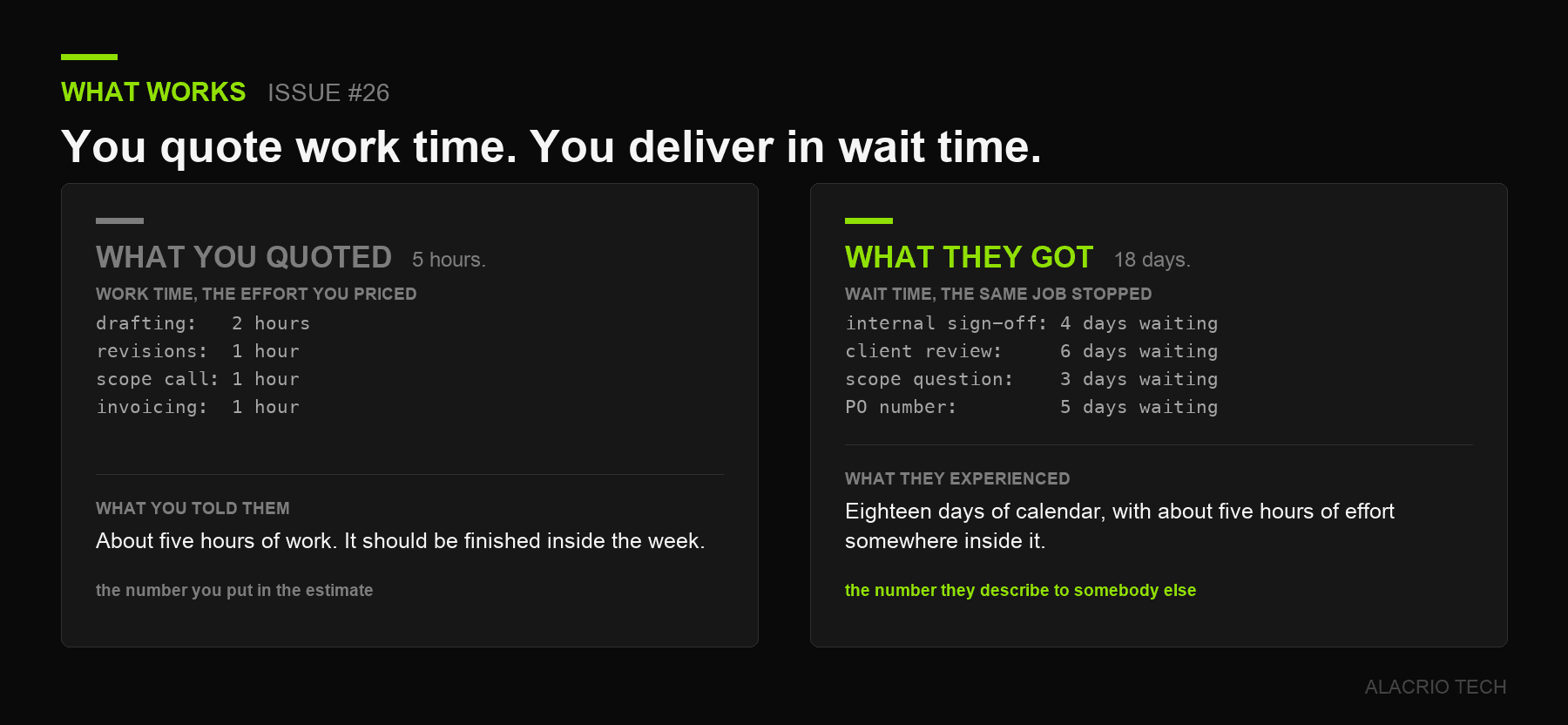 The same job measured two ways. The left column is what you quoted. The right column is what the client lived through.
Work time is what you quote. Wait time is what the client actually experiences.
Eighteen days is what they will describe to somebody else who asks what you were like to work with.
Then rank. Average wait for a step, multiplied by how often that step runs in a month. Highest number first, and ignore everything below it until the top row moves.
The multiplier is the part people skip. A six day wait that happens once a quarter costs you less than a two day wait that happens forty times a month, and the six day one is the one that feels intolerable. Sort by the total, never by the sting.
Almost nobody guesses their own top row correctly. The step that feels slow is the one you are present for, because you are the one doing it. The step that costs you is the one where nothing is happening at all and nobody is in the room to notice.
ONE PRACTICAL IMPLEMENTATION
The number tells you where. It does not tell you what to build, and that is the decision people get wrong and pay for.
An approval sits still for one of three reasons, and each one needs a different fix.
The first is that the approver never saw it. It landed in a thread with forty other things and fell below the fold. This is the only one of the three that a reminder solves, and it solves it completely. A nudge on day two, naming the item and the decision in one line, closes most of these for nothing.
The second is that the approver saw it and cannot decide, because deciding needs something you did not send. A number, a comparison, what happens if they say no. Here a reminder makes things worse. You are asking somebody to feel bad about a decision they are not equipped to make, and the reliable result is that your name starts getting avoided. The fix goes into the attachment: send your recommendation and the consequence of doing nothing.
The third is that the approver should not be in the chain at all. Somebody put them there years ago for a reason that has since gone away, and now everything under two hundred dollars queues behind a person who approves ninety-nine percent of it without reading. The fix is a threshold, agreed once and written down. Under this number, proceed and report. Over it, ask.
Telling them apart takes one question, asked the next time something sits: did you see it and not decide, or not see it? If the answer is that they saw it and approved it in their head weeks ago, you have reason three wearing reason one's clothes.
What each fix costs:
- Never saw it: a scheduled nudge. One afternoon.
- Could not decide: a decision template on every request. One hour, once, reused forever.
- Should not be in the chain: one conversation and a written threshold. Free, and usually the biggest saving of the three.
None of those is a software project, and the cheapest one saves the most. That is the normal result, and it is why the measurement comes before the build. If you automate the sending of a request nobody can act on, all you have built is a faster queue.
WHAT DOESN'T WORK
- Chasing harder. When the wait is missing information, the second and third reminder buy you avoidance rather than a decision.
- Adding an approver for visibility. Every extra name is another inbox the work can stop inside, and visibility is a report, not a signature.
- Escalating to somebody's manager as your standard move. It works once. After that people route around you.
- Measuring only your own steps. Your part of the timeline is the part that was never the problem.
- Hiring into a queue. More people means more handoffs, which means more places for the work to stop.
ONE THING TO DO THIS WEEK
Take the last five runs of the workflow that ends in you getting paid. Two dates per handoff. Twenty minutes.
- Write down every point where the work left your hands and needed somebody else.
- For each one, the date it went out and the date it came back.
- Add the gaps up, and put that total next to the hours you quoted.
- Ask the person at the top row one question: did you see it, or see it and not decide?
Finding the leak is a morning's work with a pen and your sent folder. Keeping it closed is the part that needs a system, because a wait has no owner and nothing fires when work simply stops. Alacrio exists for that second half, and the field it cares about most is whose turn it is.
If something in your business reliably takes three weeks to do six hours of work, book a free consultation.
Get the Operator in your inbox
Each Saturday I send you the Operator: an email you can send to win a client, or a template that takes a chore off your plate.
Unsubscribe anytime. I never share or sell your address.
Start with the number
You cannot fix a leak you have not found. Four minutes, twelve questions, and you will know how many hours a week you are losing and which kind they are.
Take the Manual Work ScorecardFree. No call required.