Your last few posts underperformed, so you start building a theory. Shadowban?? An algorithm change?? A penalty for putting links in posts?? Here is the number that ended my version of that theory: 5,867 impressions on one post, 53 on another, same account, three weeks apart.
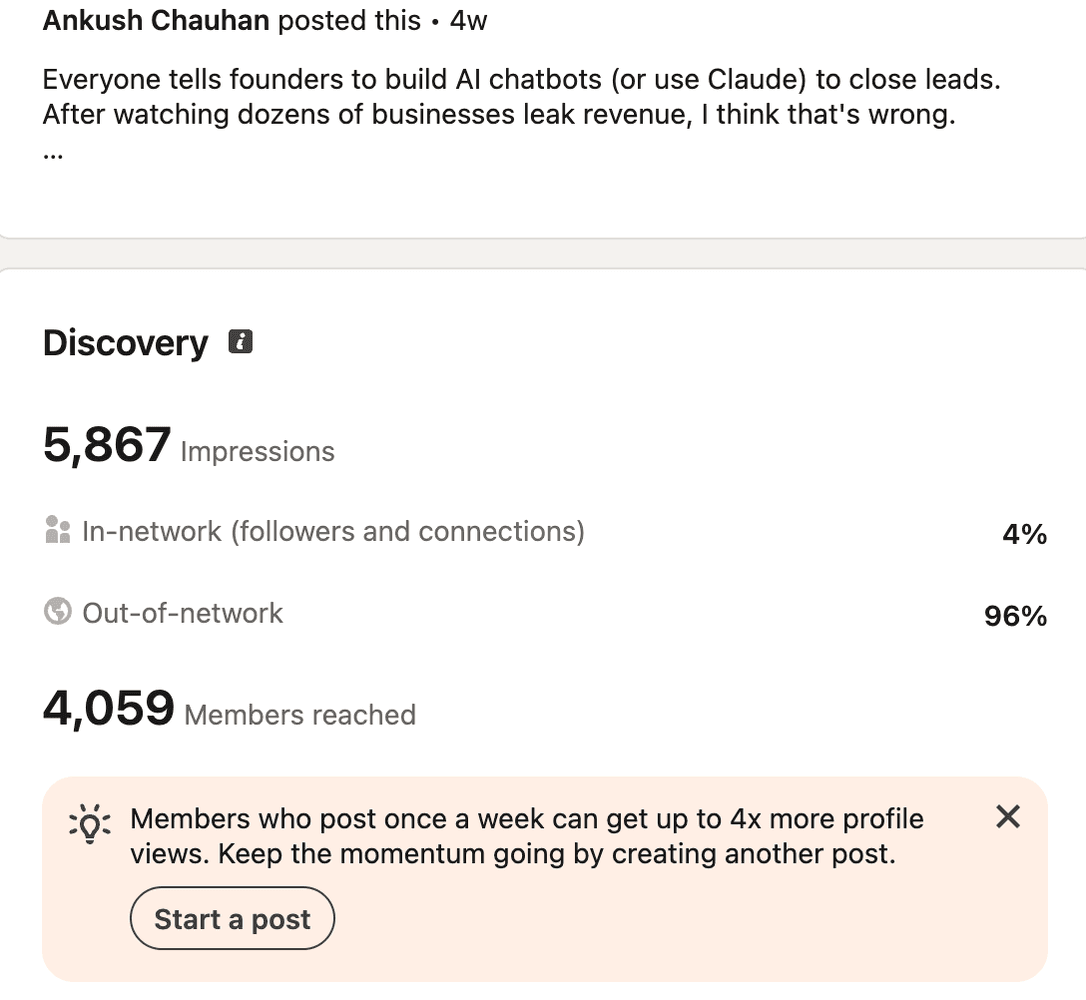 The 5,867 impression post: 4% in-network, 96% out-of-network, 4,059 members reached.
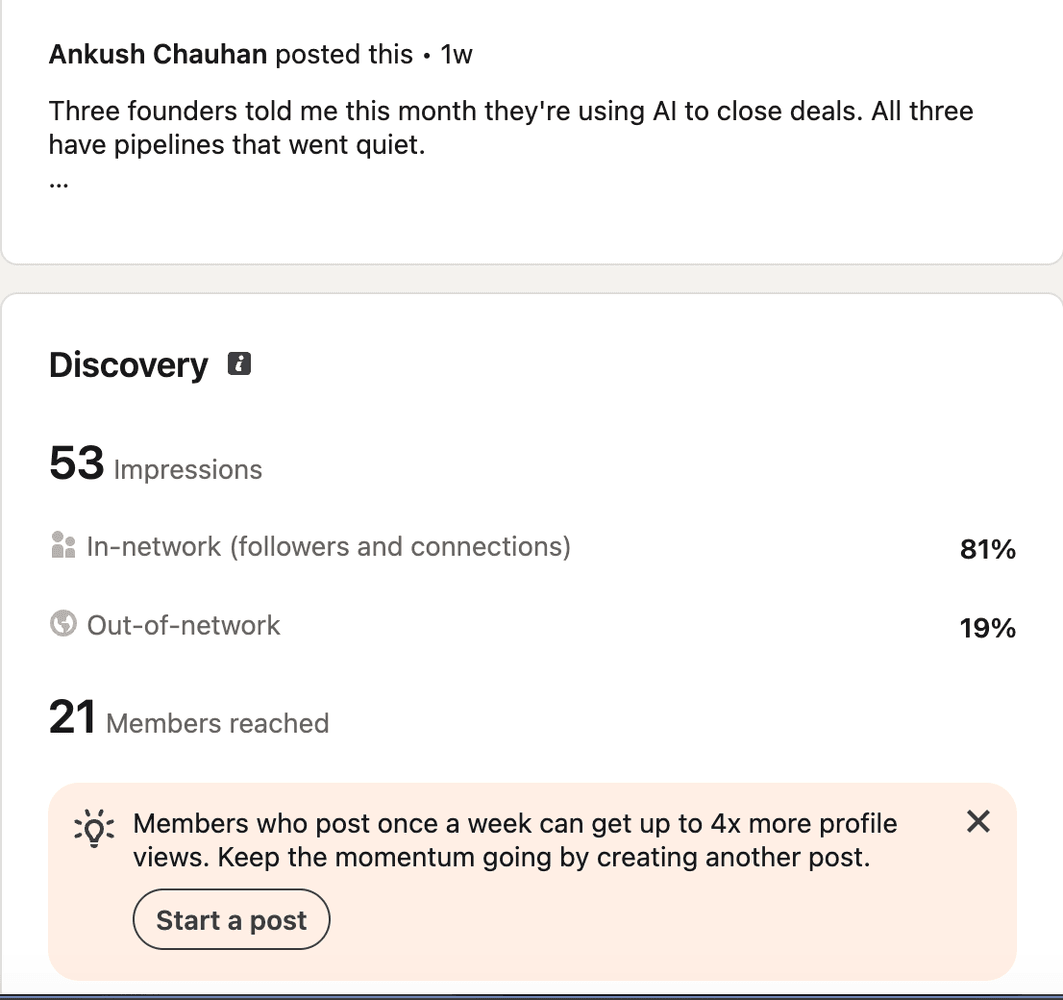 The same account three weeks later: 53 impressions, 81% in-network, 19% out-of-network, 21 members reached.
No platform penalty produces a hundredfold gap on one account in three weeks. The account was fine. One post was doing something in its first four lines that the other one wasn't.
WHAT WORKS
Stop reading the impression count. Read the network split.
Every post's analytics carries a line most people scroll straight past: how much of your reach was in-network, meaning people who already follow you, and how much was out-of-network, meaning everybody else.
Here are my two posts on that line.
5,867 impressions. 4% in-network, 96% out-of-network. 53 impressions. 81% in-network, 19% out-of-network.
LinkedIn shows a new post to a small batch of your own connections first. If that batch reacts fast enough, the post gets pushed to people who have never heard of you. If it doesn't, the post stays inside your connection list and quietly dies there.
So the split is a verdict on your first hour, not on your account.
- Mostly in-network on a quiet post: it never escaped the test batch. Your opening didn't earn a fast reaction.
- Mostly out-of-network on a quiet post: distribution was granted and something later lost people. Different problem, different fix.
Now the two posts side by side. What the 5,867 one did in its opening lines:
- Named a belief the reader already holds, then rejected it in the same breath. Everyone says do X. I think that's wrong.
- Sorted readers into two camps, the ones getting this right and the ones getting it wrong, so everybody had to place themselves.
- Framed the cost as something being lost right now, not as an annoyance to manage.
- Picked a fight people already have an opinion about.
The 53 one opened on a calm observation about other people and ended on a reflective question. Nothing wrong with it as writing. It asked the reader to remember something, and remembering is slower than disagreeing. The first hour does not wait for slow.
ONE PRACTICAL IMPLEMENTATION
Here is the audit when it is real rather than a good intention. Five columns, one row per post, your last ten.
Date, what the first line does, impressions, in-network percentage, comments inside the first hour.
Two real rows from mine:
- Jul 27 | names a consensus and rejects it | 5,867 | 4% | enough inside the hour that reach expanded
- Aug 19 | opens on a calm observation | 53 | 81% | not enough to leave the test batch
Sort the finished table by in-network percentage, highest first. Those top rows are the posts that never left your connection list. Read only their opening two lines and ask one question: what reaction does this invite in four seconds? If the honest answer is recognition, or a nice thought, you have found your pattern.
Two rules keep the table honest:
- Leave newsletter issues out of it. Those ride subscriber notifications, a completely different distribution path, and they will flatter you.
- Record what the first line does, not what the post is about. Two posts on the same topic can sit at opposite ends of this table.
WHAT DOESN'T WORK
- Judging a post by impressions alone. Impressions tell you what happened. The split tells you where it stopped.
- Posting more when reach drops. Two posts inside eighteen hours split the same first batch between them, so both start weaker than either would alone.
- Reading a good newsletter week as proof the feed is fine. Different pipe entirely.
- Declaring a penalty from three data points. Pull ten. Mine spanned a hundredfold range.
- Blaming the link preview card first. Link cards do cost you something, and it is a rounding error next to an opening nobody wants to argue with.
ONE THING TO DO THIS WEEK
Open the analytics on your last ten posts and write down two numbers for each. Twenty minutes, one sitting.
- Impressions, and the in-network percentage.
- Sort the list by in-network percentage, highest first.
- Read the opening two lines of the top three.
- Rewrite one of those openings so a stranger would want to argue with it, then post it.
The throttle theory is comfortable, because it puts the problem outside you and the fix out of reach. Your own analytics can usually kill it in twenty minutes. Mine did, and the verdict was better news and worse news at once: nothing is being suppressed, and the quiet posts were mine.
If you want a second pair of eyes on what your numbers are actually telling you, book a free consultation.
Get the Operator in your inbox
Each Saturday I send you the Operator: an email you can send to win a client, or a template that takes a chore off your plate.
Unsubscribe anytime. I never share or sell your address.
Start with the number
You cannot fix a leak you have not found. Four minutes, twelve questions, and you will know how many hours a week you are losing and which kind they are.
Take the Manual Work ScorecardFree. No call required.